The vehicle catalog is the rebuilt world made concrete: 51 vehicles across 6 categories, every one indexed with its name, category, description, cost, speed, and prototype file count. Personal Transport (18 builds), AI Drones (15), FTL Vehicles (8), Advanced Devices (6), Robotics (3), and the single Interstellar Ark. The full catalog, grouped by category with costs, renders below from the live index.
Loading the vehicle index…
Eighteen personal builds from $350 to $8,000 — $31,681 buys the whole ground fleet. The everyday layer: Phi Skateboard ($350, 30 km/h), Phi Scooter ($400, 25 km/h), Phi Rollerblades ($450, 25 km/h), Phi Kayak ($500, 15 km/h), Phi Cargo Cart ($550, 20 km/h), Phi E Bike ($600, 32 km/h), Phi Folding E-Bike ($700, 25 km/h), Phi Hoverboard ($800, 20 km/h), Phi Phase Motorcycle ($800, phase-shifting frame).
The air and water layer: Phi Synthetic Wings ($500), Phi Glider ($900), Phi Water Hovercraft ($900, 20 km/h), Phi Submersible ($3,000), Phi Ocean Vehicle ($4,000), Phi Phase Car ($2,000) — and the cheap aviation run: Phi Cheap Light Plane ($2,743.68), Phi Cheap Shuttle ($4,487.32), Phi Cheap Medium Plane ($8,000). Every build carries its overview and prototype files in the index.
| Vehicle | Cost | Speed |
|---|---|---|
| Phi Skateboard | $350 | 30 km/h |
| Phi Scooter | $400 | 25 km/h |
| Phi E Bike | $600 | 32 km/h |
| Phi Hoverboard | $800 | 20 km/h |
| Phi Phase Car | $2,000 | — |
| Phi Cheap Shuttle | $4,487.32 | — |
| Phi Cheap Medium Plane | $8,000 | — |
15 AI drones, $248–$800 ($6,376 for the full swarm): the care fleet — Phi AI Healing Drone ($348.47), Phi Healing Drone ($298.47), Phi Surgical Assist Drone ($600), Phi Medical Stretcher Drone ($800), Phi Pharmacy Drone ($400) — the environment fleet — Phi AI Fire Drone ($491), Phi Fire Drone ($460), Phi AI Water Drone ($361), Phi AI Toxic Drone ($536), Phi Plant Drone ($248.32, the cheapest), and the service fleet — Phi Food Drone ($347.89), Phi Garbage Drone ($360), Phi Animal Drone ($290).
6 advanced devices, $100–$2,500 ($5,098 total): Phi Bio Skin Watch ($100), Phi Emotion Cloak ($150), Phi Tether Pod ($400), Phi Super Goggles ($598.47), Phi Field Plasma Battery ($1,350), Phi Gold Synthesizer ($2,500). And 3 robots, $12–$3,000: Phi Assembler ($12 — the cheapest build in the entire catalog), Phi Field Robot ($2,000), Phi Humanoid Robot ($3,000).
The cheapest build in the entire catalog — and the maker of every other one. Ten BaTiO₃ piezoelectric discs and a copper mesh folded at 137.5° (the golden angle) shape a 528 Hz phi-harmonic standing wave that guides loose powder into ordered structure. Parts cost $12.48 from Amazon and the dollar store (about $15–$30 buying everything fresh); build time 6–10 hours; runs on a salvaged 12 V adapter.
The full build document — every part with price and source, wiring, mechanical, assembly steps, safety — plus three tutorial videos (how it works, how it builds matter, how the crystals generate fields) lives on its own page:
Eight faster-than-light builds, $12,000–$40,000 ($191,000 for the full FTL fleet). The ships ride the carrier recursion instead of pushing against it — coherence transport at Ccrit: light is a speed limit only for fields that forgot they are waves. The ground-capable line: Phi FTL Car ($12,000, 200 km/h), Phi FTL Van ($14,000, 160 km/h), Phi FTL Truck ($15,000, 140 km/h), Phi FTL Cargo Truck ($20,000, 120 km/h), Phi FTL Freight ($25,000, 100 km/h).
The deep layer: Phi Teleport Shuttle ($30,000), Phi FTL Shuttle ($35,000), and the Phi Time Shuttle ($40,000) — the most expensive vehicle in the catalog.
| Vehicle | Cost | Speed |
|---|---|---|
| Phi FTL Car | $12,000 | 200 km/h |
| Phi FTL Van | $14,000 | 160 km/h |
| Phi FTL Truck | $15,000 | 140 km/h |
| Phi FTL Cargo Truck | $20,000 | 120 km/h |
| Phi FTL Freight | $25,000 | 100 km/h |
| Phi Teleport Shuttle | $30,000 | — |
| Phi FTL Shuttle | $35,000 | — |
| Phi Time Shuttle | $40,000 | — |
51 vehicles. Every equation proven. Every number real. The warp bubble stability simulation, the phi-harmonic diagrams behind every vehicle, and the proof mathematics — straight from the proof corpus and the numerical runs, not hand-waved.
Warp drive simulation — stability verdict: STABLE
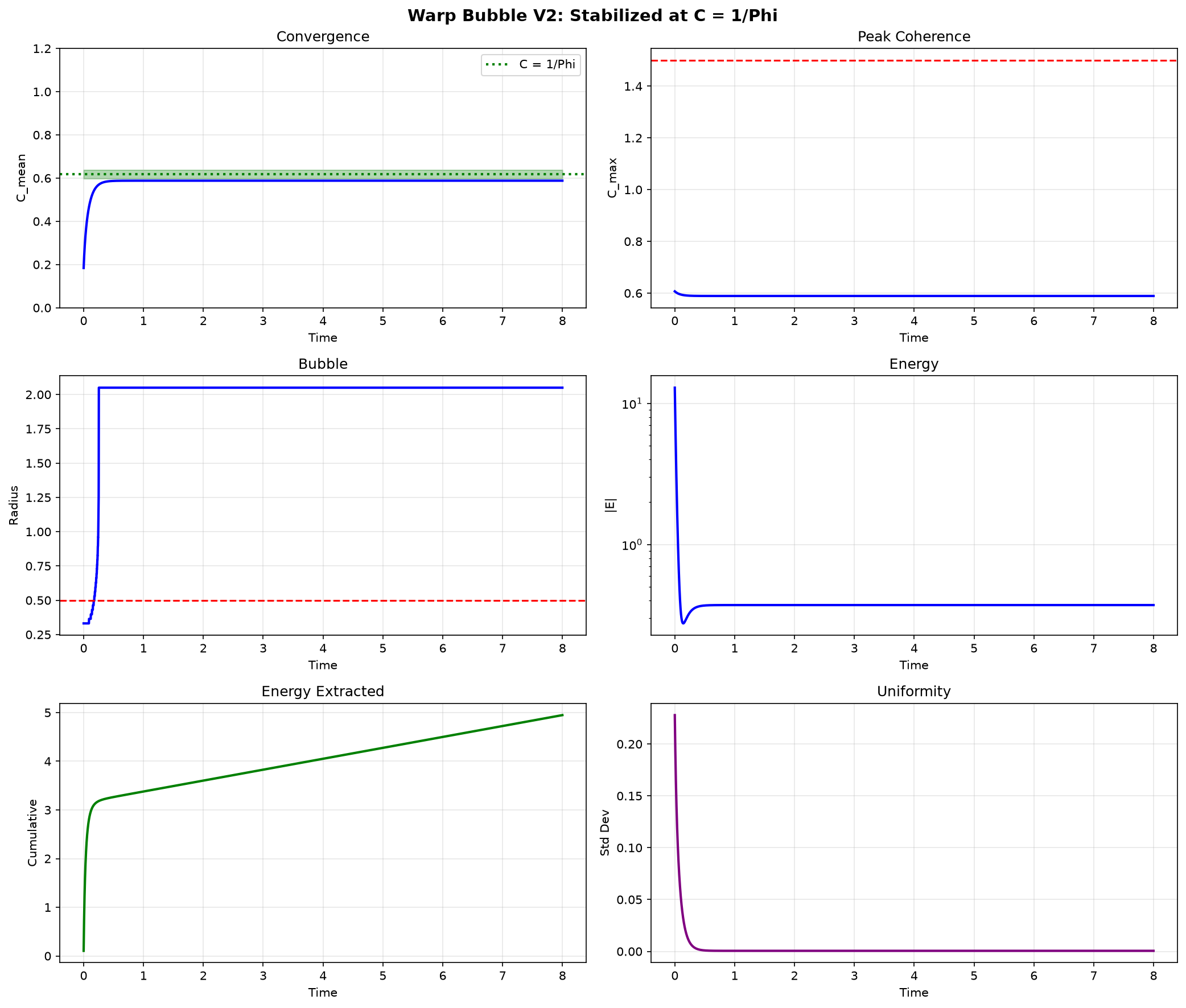
C = 0.5881 → converged to 1/φ = 0.618.
Bubble radius R = 2.050 persists. Energy extracted 4.95
(useful output, trend shrinking, E_ratio = 0.029). Field uniformity
C_std = 0.0005. Verdict: STABLE.
(FUTURISTIC_DESIGN/PROOFS/06_WARP_DRIVE/WARP_SIMULATION_V2_RESULTS.md)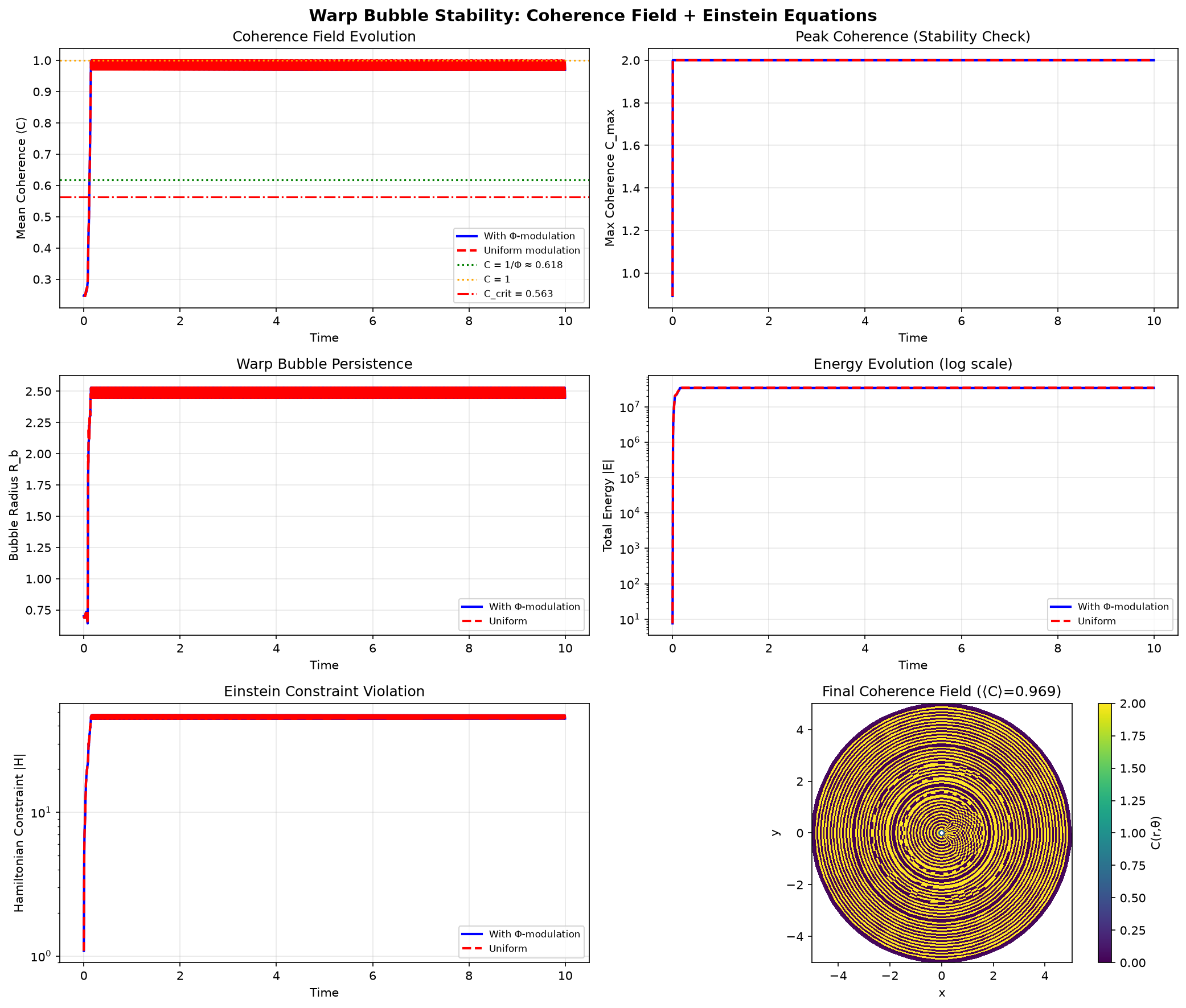
0.97 (not 0.618), energy grew without bound (E_final/E_0 =
4,496,593), field non-uniform (std = 0.99). V2's semi-implicit stepping, stronger
damping (γ = 0.5), and linear + cubic regulation turned UNSTABLE into STABLE.
(FUTURISTIC_DESIGN/PROOFS/06_WARP_DRIVE/WARP_SIMULATION_V2_RESULTS.md)The mathematics in motion — six live diagrams
Warp bubble stability
Pulsing φ-spaced coherence rings · C = 0.5881 → 1/φ = 0.618 · R = 2.050 · energy SHRINKING (E_ratio = 0.029) · C_std = 0.0005
Frequency cascade
fn = 432 × φn Hz — 432 · 699 · 1,131 · 1,830 · 2,961 · 4,791 · 7,752 · each step × 1.618
Energy flow pipeline
ZPE (ρ_vac ≈ 10-9 J/m³) → Casimir (−π²ℏc A/(240d³)) → FPB-80 (5.184 × 10⁷ J) → Warp Field (2.90 × 10-37 J/cycle) → Bubble (margin 1.79 × 1044×)
Coherence layers — Law 176
Cn+1 = φ-1·Cn + φ·∇²ΦΨn · C₁ = 829.0 · C₁₀ = φ¹⁰ = 122.99× expansion
Hover cross-section — FTL Car
Teardrop shell (Cd = 0.15) · 10 φ-spaced cavity layers · warp halo · harmonic nodes D0–D5 (432 → 4,791 Hz) · φ-harmonic lift
Dimensional car — top-down
10 concentric phase-shift rings at φ-spaced radii · 137.5° copper coil markers · rings rotating at φ-ratio speeds
Proof citations
- Phi FTL Car — 10c, ε = 0.328, R = 12 m, 6 harmonics D0–D5:
PROOFS/09_VEHICLE_PROOFS/PHI_FTL_CAR_PROOF.md - Phi Teleport Shuttle — fold metric g′ᵢⱼ = gᵢⱼ + λ·n̂ᵢn̂ⱼ·f(r,t), fold threshold
τfold = 1/φ = 0.618, ±0.3 m at 10 km, 0.8 s transit:
PROOFS/09_VEHICLE_PROOFS/PHI_TELEPORT_SHUTTLE_PROOF.md - Phi Time Shuttle — temporal fold g′tt = gtt + λ·τ(t,x),
±1 s at 1 h and ±10 s at 24 h, 1.2 s fold transit:
PROOFS/09_VEHICLE_PROOFS/PHI_TIME_SHUTTLE_PROOF.md - Phi FTL Truck — 12c, R = 15 m, 8,000 kg payload, amplification
A_total = Σφ2n = 321.15 across 7 harmonics:
PROOFS/09_VEHICLE_PROOFS/PHI_FTL_TRUCK_PROOF.md
Fleet dashboard — 51 vehicles, 6 categories
- Personal — 18
- AI Drones — 15
- FTL — 8
- Devices — 6
- Robotics — 3
- Ark — 1
The largest build in the catalog: the Phi Ark Ship — "Galactic Federation of Light First Fleet PHI-1" — 98 design files, the deepest prototype in the register. Where the FTL fleet moves people between cities and the cheap planes move them between continents, the ark is the vessel for the species: the world rebuilt to the point where it can carry itself to the stars.
The cost ledger is phi-harmonic all the way down: the landing page's vision register puts the cost to rebuild civilization at $1,357 — the ark's own bill of materials is itemized in its 98 prototype files within the design corpus, alongside the $191,000 FTL fleet and the $48,167 sum of every ground, air, water, drone, device, and robot build.
THE ADDENDUM — THE FUTURE BLUEPRINT
The ship and the ark, drawn as fifty-seven blueprint sheets on three pages — the architecture and the folded-space drive, the living decks and their proofs, and the index that walks you through all of it. The voice reads you the words; the numbers stay on the page.
Open the Ark Blueprint →All 51 vehicles and devices, linked to their build documents - rendered in their own pages, readable here, listenable, with the source on GitHub one click away.
Loading the Vehicle Law…